


How to create a calm classroom: A journey down the 4 Cs Pathway
- Amy Such

- Mar 23
- 3 min read
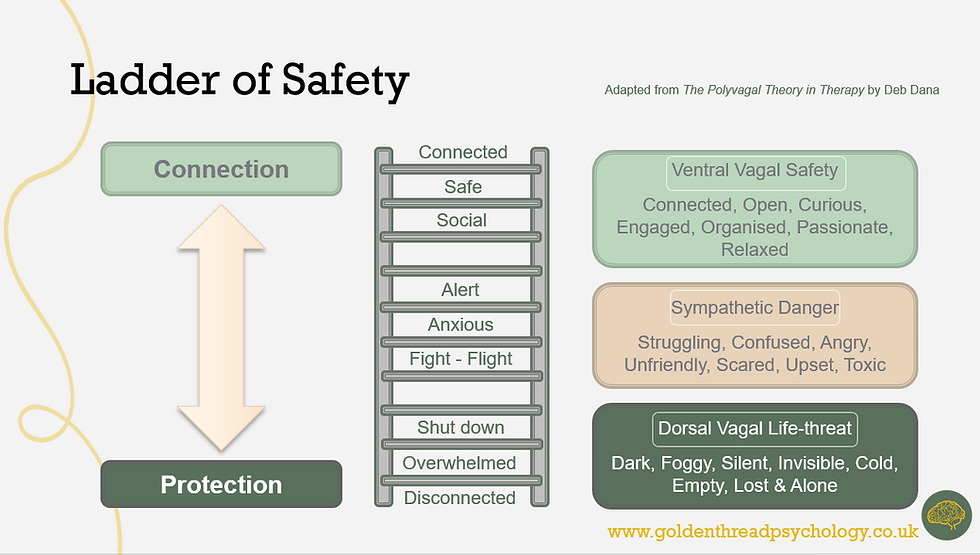
What do we know about accessing education? For us to learn, we have to feel safe. Our nervous system has to be open to receiving new information, our executive functioning skills need to be ‘online’ to sort that information and our ‘fight/flight’ mode must feel calm enough to take risks, embrace challenges and accept constructive feedback.
To be in this safe, settled state, our natural environment also needs to reinforce that we are OK. When the classroom feels hectic, unpredictable or uncontrollable, our nervous system will be on high alert and move us from a place of connection (and learning) to a place of protection (or shut down).
In May 2025 (National Behaviour Survey), 63% of teachers reported that they felt their schools were calm and orderly ‘most days’ or ‘every day’. This is an improvement from the previous survey (May 2023), where only 59% of teachers felt that way. However, it remains that a third of teachers and 43% of secondary school students do not see schools as calm, orderly places.
Further still, almost three quarters (73%) of teachers reported that pupil misbehaviour had had a negative impact on their health and wellbeing, and only one third of classroom teachers reported feeling ‘very confident’ managing what the survey termed ‘misbehaviour’.
With many schools now shifting away from classroom management systems based around behaviourist principles, and adopting relational approaches instead, it’s important to consider how we move from a place of behaviourism and control, to that of relationships and connection.
Introducing the 4 Cs Pathway
Using the 4 Cs Pathway, we can map out the journey from a place of chaos to a place of calm. Although this model is linear, we recognise that in reality, you’ll likely travel back and forwards along the path multiple times in a day… or even a lesson! However, by having the 4 Cs in mind, you can acknowledge where you’re at and think about what your next steps might be, grounded in psychological theory and evidence.

1) Control – walking into a classroom as an adult or a pupil, you’re most likely going to start in a place of needing control. Thinking back to the beginning of this blog, this harps back to our nervous system, and our innate need to feel safe. When we feel under threat, we might demonstrate a ‘fight/flight’ response and that can lead us into a power battle with our pupils. Does this sound familiar?
2) Courage – to move away from this power struggle, we need to find courage. This is probably the trickiest part of the journey and we realise this is not an easy thing to do! Here, we need to find the courage to give up a little bit of that control in order to progress forward. To find courage, we can draw upon the principles of Acceptance and Commitment Therapy (ACT), thinking specifically about Circles of Control and accepting the things that are beyond our control but committing to meaningful action around the things we can control.
3) Compassion – next, we must show compassion. To do this, Compassionate Communication (embedded in Non-Violence Resistance; NVR) teaches us to identify the needs of everyone in a given situation and think about the power of language in order to reposition that power struggle. If we’re able to do this successfully, the situation should shift from ‘us versus them’, to everyone’s needs being met.
4) Connection – the final step on the journey to calm is connection; the feeling of belonging, exercising empathy and attunement through techniques such as Emotion Coaching and Restorative Practice. At this stage, the aspiration is to be doing things with the pupil, rather than to them or for them.
Once you’ve come to a place of connection, everyone should be feeling safe and secure within the classroom environment. At this point, relational policies (rather than behavioural policies) can be applied with confidence and the benefits of a calm classroom can be enjoyed.
Reduced stress – a calmer classroom leads to less stress for the teacher.
Boosted relationships – a less stressed teacher leads to improved teacher-pupil relationships.
Increased learning – with the quality of relationships improved, pupils are able to take greater risks with their learning, knowing that they have the support of the teacher should anything go wrong.
Enhanced social skills – taught through direct tuition as well as the modelling of desirable behaviours.
Improved behaviour – connection aids co-regulation, where children feel listened to, valued and supported.
Greater emotional awareness – an overall increase in emotional intelligence not only supports emotional regulation in others, but also in ourselves.
If you’d like to learn more about the 4 Cs Pathway, or request information on our School Twilight Training Package, please contact hello@goldenthreadpsychology.co.uk or phone 07452 702287.


Comments