


Polyvagal Theory: From Protection To Connection

We’ve heard about our fight/flight/freeze response, but what’s really going on there? Why is it that some children run to their trusted adult for comfort, whereas other children will hide away or turn their backs on support?
Developed by Dr Stephen Porges, Polyvagal Theory suggests that our nervous system is constantly scanning the environment for signs of safety or threat. This process, often happening outside of our awareness, can be mapped onto a Ladder of Safety (Deb Dana).
Ladder of Safety
When we feel safe, our actions are guided by our ventral vagal system. This allows us to be open, curious, relaxed and socially engaged.
As we move away from safety and begin to sense danger, our sympathetic nervous system comes online. This is designed to speed us up and get us moving - this is where ‘fight/flight’ comes in! We might notice feeling angry, confused or scared.
At the bottom of the Ladder, our dorsal vagal system leads us into shut down mode. This is where the threat is so great that we disconnect from the world and experience feelings of isolation, emptiness and loss.
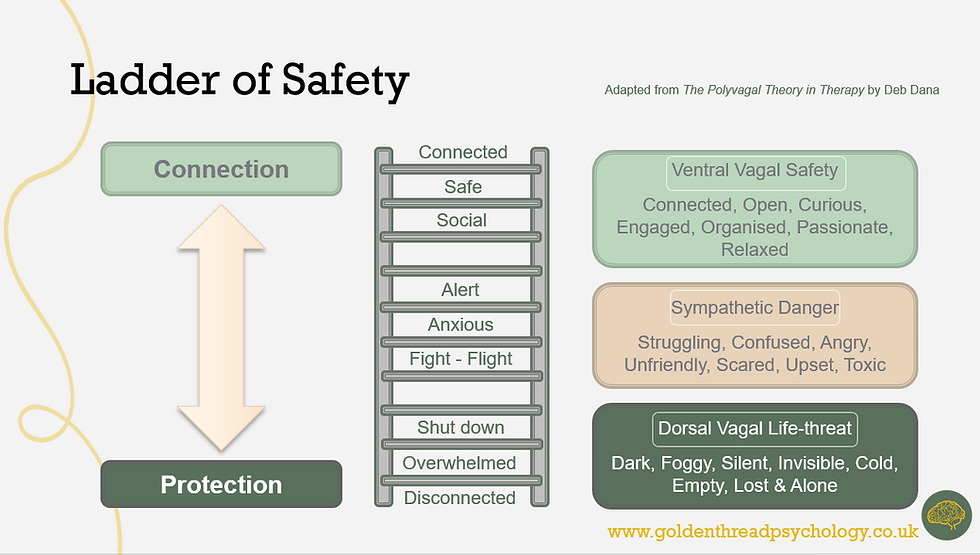
Where we sit on the Ladder of Safety influences whether we move towards connection (feeling safe and social with others) or towards protection (moving to disconnection and shutdown as a way of keeping ourselves safe).
How might this look in the classroom?
When a child feels safe, their nervous system is in a state that supports social engagement. They are more likely to make initiate interactions, communicate, play, explore, learn, and seek comfort from trusted adults. In this state, relationships feel accessible and the world feels manageable. We might describe these children as calm, curious, flexible and connected.
However, when a child's nervous system detects danger, whether the threat is real or perceived, their priority shifts from connection to protection. Learning, reasoning, and cooperation become secondary to survival.
For some children, protection looks like mobilisation. They may become anxious, restless, argumentative, aggressive or hyperactive. Their nervous system is preparing them to fight or flee. Adults can find these behaviours difficult to respond to, yet beneath it is a nervous system doing its best to stay safe.
For others, they may move further down the Ladder, with protection taking the form of shutdown. They may withdraw, become quiet, appear disengaged or struggle to respond. In these moments, the child is not choosing to be difficult or uninterested. Their nervous system may be conserving energy and protecting them from overwhelm.
What can we do to support?
Understanding behaviour through a polyvagal lens invites a shift in perspective. Instead of asking "what's wrong with this child?", we can ask "what is this child's nervous system responding to?" and "what might help them feel safe enough to reconnect?"
This is where co-regulation becomes so important. Children borrow safety from the adults around them. To communicate to a child that they are safe, we can use:
A calm voice
Predictable routines
Warm facial expressions
A regulated presence
Before children can access logic, reflection or consequences, they often need connection.
Polyvagal Theory reminds us that behind every behaviour is a nervous system trying to do its job. When we recognise whether a child is moving towards connection or towards protection, we can respond with greater compassion, curiosity and effectiveness. Rather than rushing in to correct behaviour, we can prioritise creating the conditions that help children feel safe enough to connect, engage and thrive.
For further information on how this might be achieved, please contact hello@goldenthreadpsychology.co.uk and ask about our ‘4Cs Pathway’ training, exploring how we introduce compassion and curiosity into our classrooms in a way that feels safe and manageable for staff.


Comments